Nazi persecution of Jews
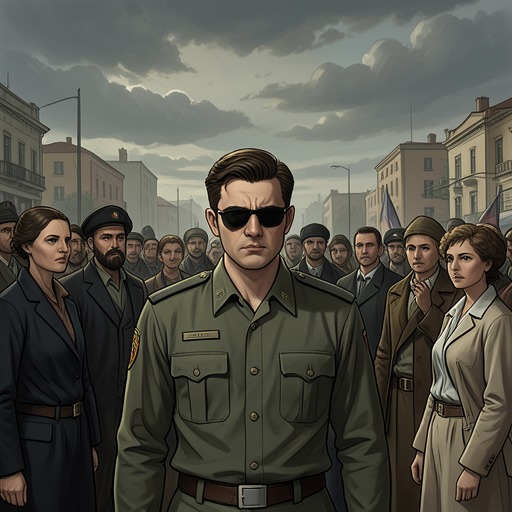
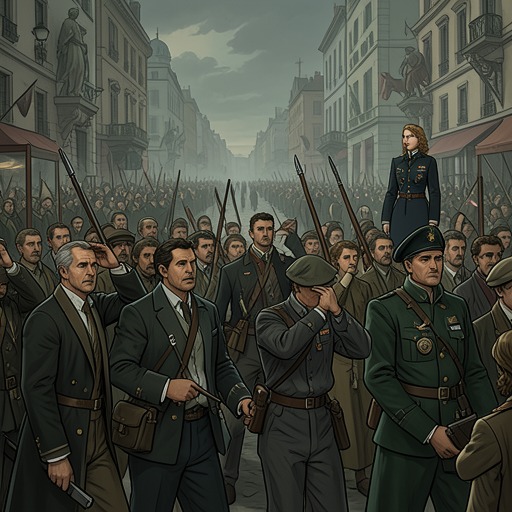
The Book ThiefNazi persecution of Jews is not presented as a single eruption of violence but as a system that makes exclusion ordinary before making destruction possible. Its progression can be traced through political labels, discriminatory law, economic expulsion, public terror, concealment, forced movement, labor, and murder. The experiences of Max Vandenburg and the Jewish prisoners seen by Liesel Meminger show how the system converts people into targets while leaving their individuality, memory, fear, and capacity for friendship painfully visible.
From Labels to Legal Exclusion
The persecution begins with classification. Liesel Meminger knows almost nothing about her absent father except a label she cannot understand: communist. Her dark brown eyes also place her uneasily within a Germany that has begun assigning dangerous meanings to physical and political identity. When she later connects the word communist, a great bonfire, dead letters, her mother’s suffering, and her brother’s death, she arrives at the Führer as the force linking private grief to public ideology. The connection shows how persecution enters a child’s understanding not as an abstract doctrine but as a pattern joining family loss, propaganda, and state power.
The same system defines Jewishness as a legal and social condition of exclusion. The Nuremberg Laws forbid Jews to hold German citizenship and prohibit marriage between Jews and Germans. Max Vandenburg is dismissed with other Jews from the Jedermann Engineering Factory in 1935, so the law reaches beyond personal prejudice into employment, citizenship, and ordinary economic survival. Alex Steiner’s contradictory politics sharpen the distinction between official membership and private belief: he belongs to the Nazi Party but does not hate Jews or anyone else. His position does not cancel the system’s violence; instead, it reveals how a person can participate in its institutions while refusing its stated hatred.
Public Terror and the Destruction of Belonging
In the spring of 1937, Hans Hubermann finally submits an application to join the Party, almost to his shame, after Jews have been terrorized at random throughout the country. Immediately afterward, he witnesses men attack Kleinmann’s, one of the few Jewish shops still operating in Molching. Bricks break the windows, a yellow star is smeared on the door, and the words Jewish filth are written across it. Hans asks whether the shopkeeper needs help, but the scene makes clear that violence is being carried out not only by individual attackers. It is surrounded by political pressure, public permission, and the fear that makes intervention dangerous.
Kristallnacht, on November 9, 1938, turns that atmosphere into a national catastrophe. Jewish establishments are smashed and looted, and Max, then twenty-two, is trapped in a crowded apartment with his aunt, mother, cousins, and their children. Yet the same night that destroys so many Jewish families becomes Max’s opportunity to escape. Walter Kugler arrives at the apartment door and offers a route out, demonstrating the novel’s central contrast between a state organized around racial persecution and private relationships that cross the boundaries imposed by that state.
Hiding, Hunger, and the Body Under Siege
For two years Max remains hidden in an empty storeroom in a building where Walter had once worked. The conditions are defined by very little food and abundant suspicion. Families with money attempt to emigrate; those without money try as well but usually cannot succeed. Max’s family belongs to the latter group, while Walter checks on them only occasionally and as inconspicuously as possible. Hiding is therefore not safety in any complete sense. It is an unstable interval in which survival depends on secrecy, access to food, and the continued courage of another person.
Max’s history with Walter makes that rescue especially significant. The two fought thirteen times as adolescents, with Walter winning ten bouts to Max’s three, before grudging respect became genuine friendship. After Jewish workers were expelled from the factory, their meetings became sporadic, and Max was steadily rejected while Walter disappeared into work at a printing firm. The friendship survives not because persecution leaves their earlier rivalry untouched, but because it gives Walter a reason to act when the political order insists that Max is no longer entitled to ordinary human protection.
The physical consequences of concealment become severe. Max spends time on cool cement while the minutes and hours grow cruel and punishing. Later, during a serious decline in health, he is constantly cold, his hands swim with weakness, and his visions of boxing with the Führer intensify. He cannot warm himself beside the fire, loses weight, and gradually abandons his exercise regimen, sometimes lying with his cheek against the basement floor. By early February he sleeps well into the morning, his mouth distorted and cheekbones swelling; when asked, he says he is fine. The condition makes persecution material rather than merely ideological: the state’s pressure is registered in hunger, cold, exhaustion, and the failing body.
From Surveillance to Forced Movement
Persecution also operates through the threat of discovery. When Hans exposes himself by helping a Jewish prisoner, his punishment begins as conscience: he can no longer play the accordion, and his wounded optimism follows him to the dinner table and the bridge over the Amper. Soon a letter arrives informing him that his application to join the NSDAP has been approved. The document appears to offer good news, but its timing gives it another meaning. Party membership becomes inseparable from the danger created by his compassion, and the approval arrives as an institutional response to his transgression.
The regime’s control extends into domestic space. As Nazis move down the street, they paint LSR, Luft Schutz Raum, on doors to identify air-raid shelters. The marking appears practical, yet it belongs to the same administrative world that classifies people, homes, and permissible movement. Hans warns Liesel that if she tells anyone about the hidden man, consequences will reach her teacher and Rudy. The secret is thus held under a chain of possible punishments, with the household transformed into both refuge and site of surveillance.
Public display disguises the larger system’s lethal purpose. People on the street are shown the supposed glory of a labor camp such as Dachau, even while the death camps remain secret. The euphemism of labor conceals a structure in which prisoners are deprived of ordinary rights and compelled to work and walk under conditions designed by persecution. By the time Liesel sees the prisoners, the difference between public spectacle and organized death has become impossible to maintain.
Prisoners, Camps, and the Erasure of the Person
The prisoners who pass along Munich Street appear as a moving catalogue of colors, starving bodies, ragged uniforms, enormous eyes, and dirt molded to their skin. Soldiers push them into brief, forced runs before they collapse back into malnourished walking. The description refuses to let the crowd become anonymous. Each person is imagined as someone who will die and as a final human encounter for Death, whose narration follows bones, souls, and physical bodies separately. The result is a contrast between the state’s reduction of Jews to a category and the narrative’s insistence on their singularity.
The camps extend the same violence across Europe. At Auschwitz and Mauthausen, death is imagined through souls rising from gas chambers and through bodies falling from a great cliff. The smoky sky and stove-like smell coexist with cold, while the dead are rendered light, like empty walnut shells. This estranged perspective does not soften the horror; it makes the scale of killing newly perceptible by shifting between the physical shell and the person who has been taken from it. The persecution is therefore both bureaucratic and intimate, carried out through institutions while ending in individual bodies.
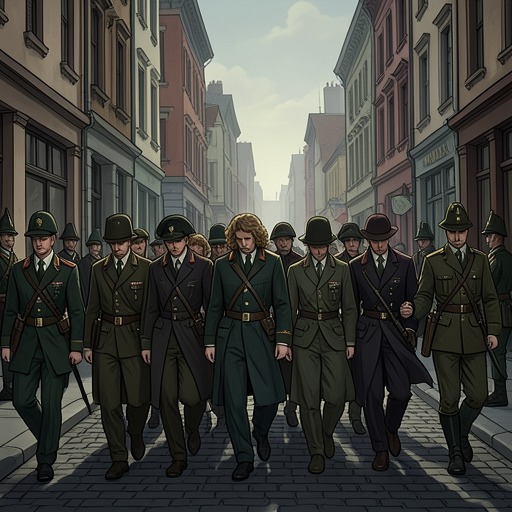
Max becomes one of those Jews forced to work and walk in the camps as the war and extermination continue. Years after leaving Himmel Street, he is captured near Stuttgart and driven with other prisoners. When he and Liesel meet again, his starving arms cannot push her away. She walks beside him through the filth, hunger, and confusion until a soldier notices and tries to separate them. Their reunion makes the political system’s movement visible: a hidden man has become a prisoner in a ragged column, while the child who once sheltered him can offer only the dangerous recognition of his name and face.
Meaning and Moral Contrast
Nazi persecution of Jews gains its force in the novel through its gradual escalation. It begins with names and labels, becomes law, reaches the shopfront through stars and insults, enters the home through fear, and finally governs the prisoner’s body through camps and forced marches. The sequence exposes the continuity between apparently separate acts: citizenship can be withdrawn, employment denied, businesses destroyed, people hidden, and prisoners transported because each stage has already narrowed the definition of who counts as protected.
The novel nevertheless places this system beside acts that contradict its categories. Walter Kugler’s friendship with Max outlasts the racial boundary imposed by law. Hans’s impulse to help Kleinmann’s and his later remorse show how conscience can survive inside compromised institutions, even when compassion brings punishment. Liesel’s recognition of Max during the prisoner parade does not stop the soldier or undo the camp, but it restores a relationship where the regime demands only a persecuted identity. Against the state’s language of plague, filth, and criminality, these acts insist that Jewish prisoners remain friends, family members, workers, children, and human beings.
The persecution’s significance therefore lies not only in the suffering it produces but in the method by which it makes suffering appear legitimate. Its power depends on ordinary people accepting labels, documents, markings, and public rituals as substitutes for judgment. By tracing the process from a child’s confusion over the word communist to Max’s forced march and return, the narrative shows how a political order can turn prejudice into procedure and procedure into mass death—while also showing that individual recognition, however endangered, can refuse the final erasure.